
Digital Hemodialysis Management Platform
Machines, HIS, LIS and treatment records on one data layer. Cloud-hosted, no on-site maintenance, compliant with national medical data security rules.
Platform Use Cases
From standalone centers to chain networks, flexibly adapting to dialysis centers of all sizes
Standalone Centers
Real-time monitoring and intelligent alerts to enhance treatment safety and standardization.
Chain Dialysis Centers
Centralized oversight and unified quality control to support scalable, standardized operations.
Clinical Decision Support
Data-driven insights to help physicians make more precise treatment decisions.
Core Feature Modules
End-to-end coverage across rounds, labs, care management, and monitoring—supporting an intelligent upgrade for dialysis center operations
Consultation Module
Voice input + AI real-time optimization, making EMR documentation effortless
Solving the doctor's pain point of 'say it once, write it again'. During daily patient communication, the AI assistant automatically captures speech and converts it to standardized medical terminology in real-time.
Problem List Management
Create comprehensive problem lists for each patient with searchable historical treatment plans. Unresolved and resolved issues displayed on a single page for easy access to treatment history, ensuring continuity and accuracy in care planning.
Expert Consultation Support
Designed for department chiefs' consultation needs with 'Key Problem Organization' feature. Keep unresolved issues in the list for quick expert access. AI voice capture greatly simplifies post-consultation task distribution and organization.
AI: AI assistant voice capture greatly simplifies post-consultation task distribution

Lab Results Evaluation Module
Deep integration of expert wisdom, evolving each small step from task to precision unit
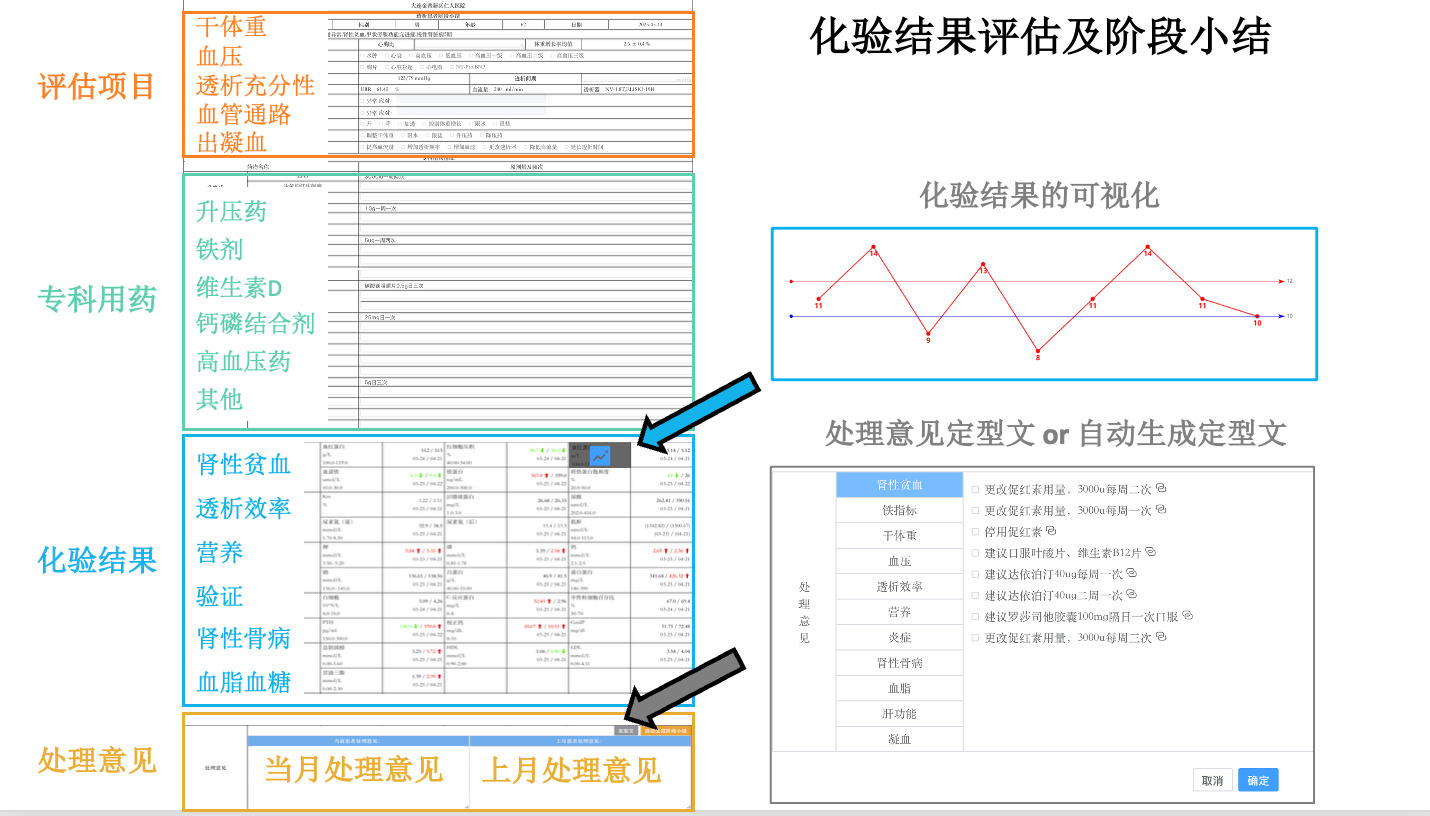
This module builds a highly integrated digital evaluation page, eliminating the hassle of switching between different pages. Refined display with medication records and graphical lab trends side by side, intuitive observation of all historical values, precise medication adjustment impact on lab indicators.
Data-Driven Clinical Decisions
Laboratory results are filed as structured records against a standard template, so a clinician can complete the write-up quickly. Drafts are for reference and take effect once the clinician confirms them.
One-Click Clinical Reports
Generate and print comprehensive reports featuring graphical lab trends with personalized treatment recommendations. Visual paper reports enable clearer patient communication, significantly enhancing treatment acceptance, trust, and adherence.
AI: AI-powered preset templates for rapid clinical recommendation generation
Foot Care Management Module
Structured screening and tiered care management, with a record at every step
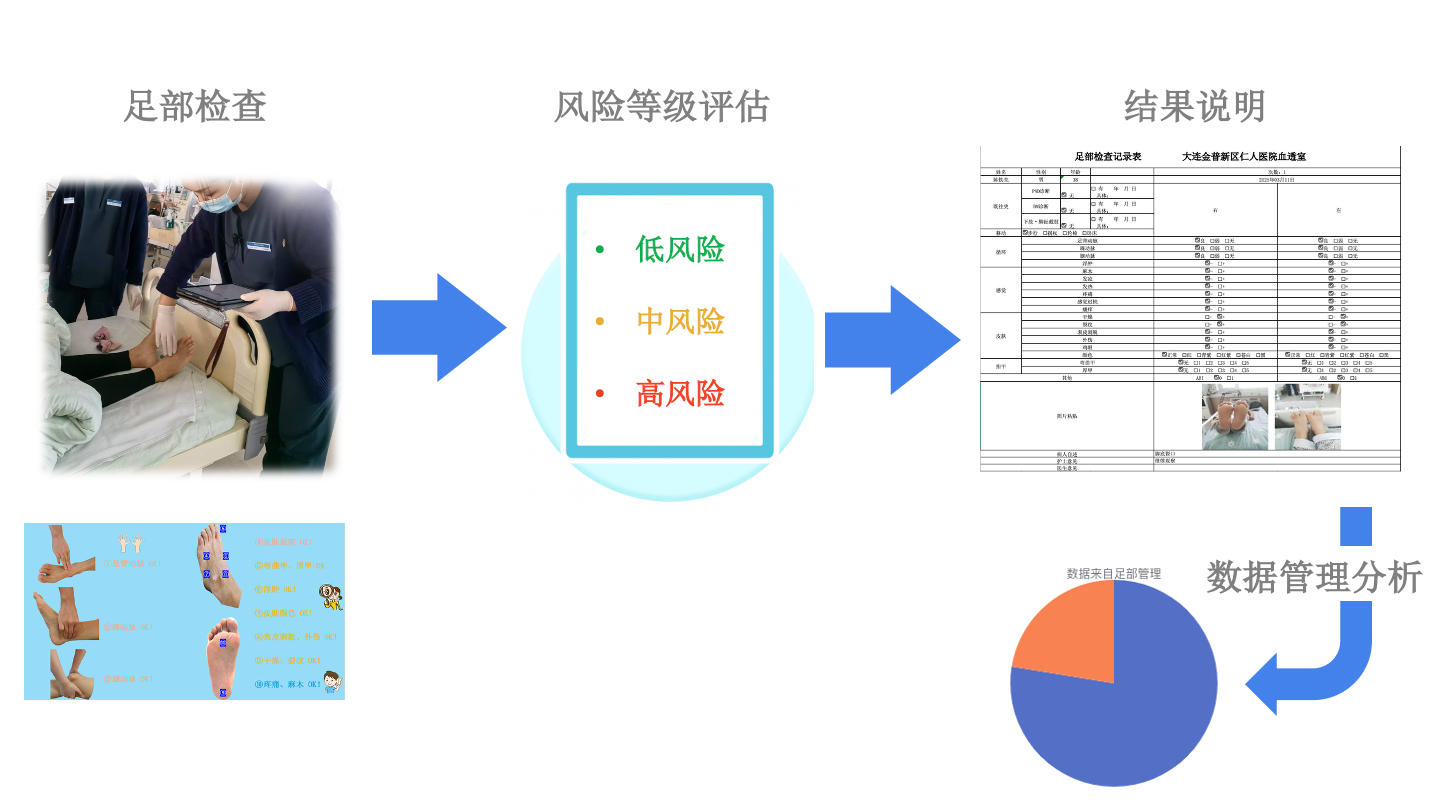
Comprehensive assessment of lower limb arterial pulse, neurological sensation, skin integrity, and nail condition. The system captures subtle changes in foot health status. Instant wound photography with archival storage enables visual trend tracking through historical photo comparison. Multi-dimensional risk stratification automatically identifies high-risk patients, enabling early intervention and targeted prevention.
Risk Classification
Patient records are grouped by rules the center configures, so the nursing team can find who needs attention first. The center sets the grouping; whether to intervene is the clinical team's decision.
Photo Comparison Tracking
Time-based before/after photo comparison, making condition evolution trends immediately visible.
AI: System automatically completes risk classification based on multi-dimensional data
Dry Weight Assessment Assistant
Smart weight trend tracking, scientific dry weight assessment, optimized UF planning
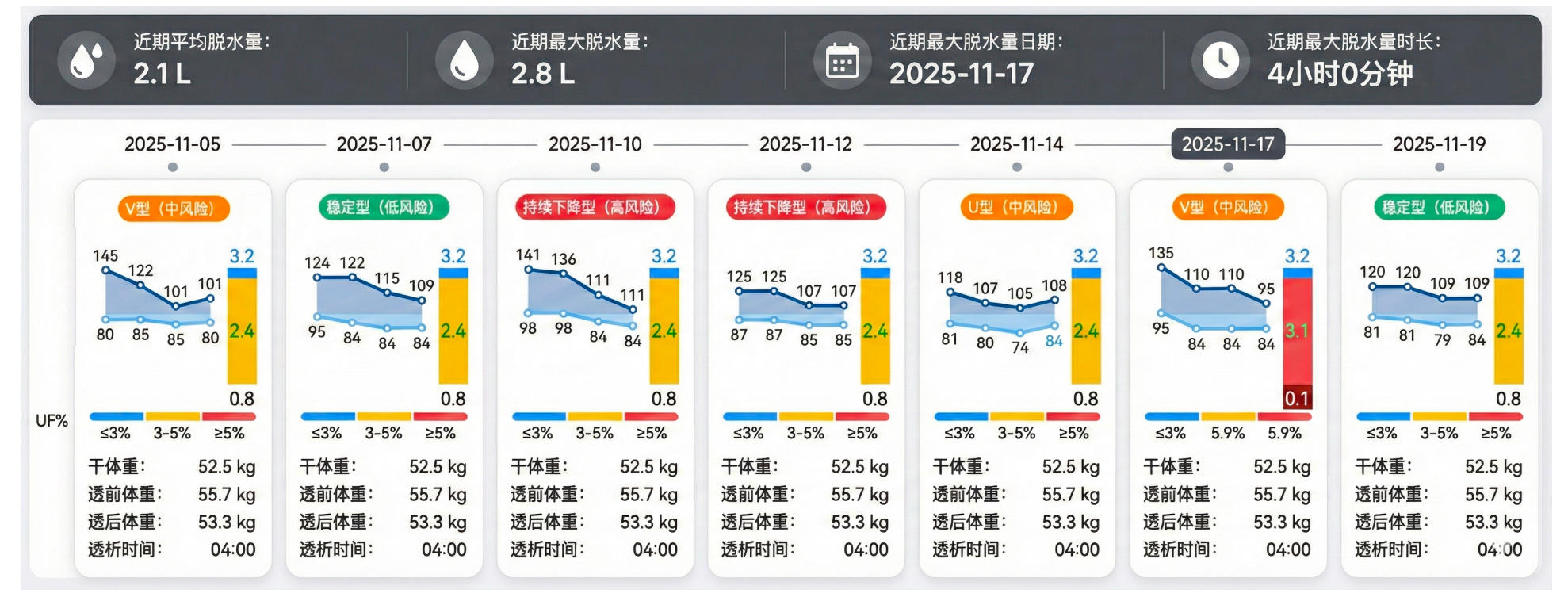
Pre- and post-dialysis weights are recorded automatically and presented alongside ultrafiltration volume and blood-pressure change as a trend view for the clinician to read. Assessing and adjusting dry weight remains the clinician's.
Smart Weight Trend Tracking
Auto-records pre-dialysis weight, post-dialysis weight, UF volume, generating visual trend charts to clearly show weight patterns and dry weight deviations.
Dry Weight & Blood Pressure Trends
Blood-pressure patterns, ultrafiltration tolerance and oedema records are gathered into one view, so a clinician can re-check the current dry weight setting. The dry-weight models remain research programmes.
AI: Weight trends and related records on one screen, for the clinician to review
Lab Reminder Module
Managing varying lab frequencies - weekly, periodic - is often the most challenging aspect
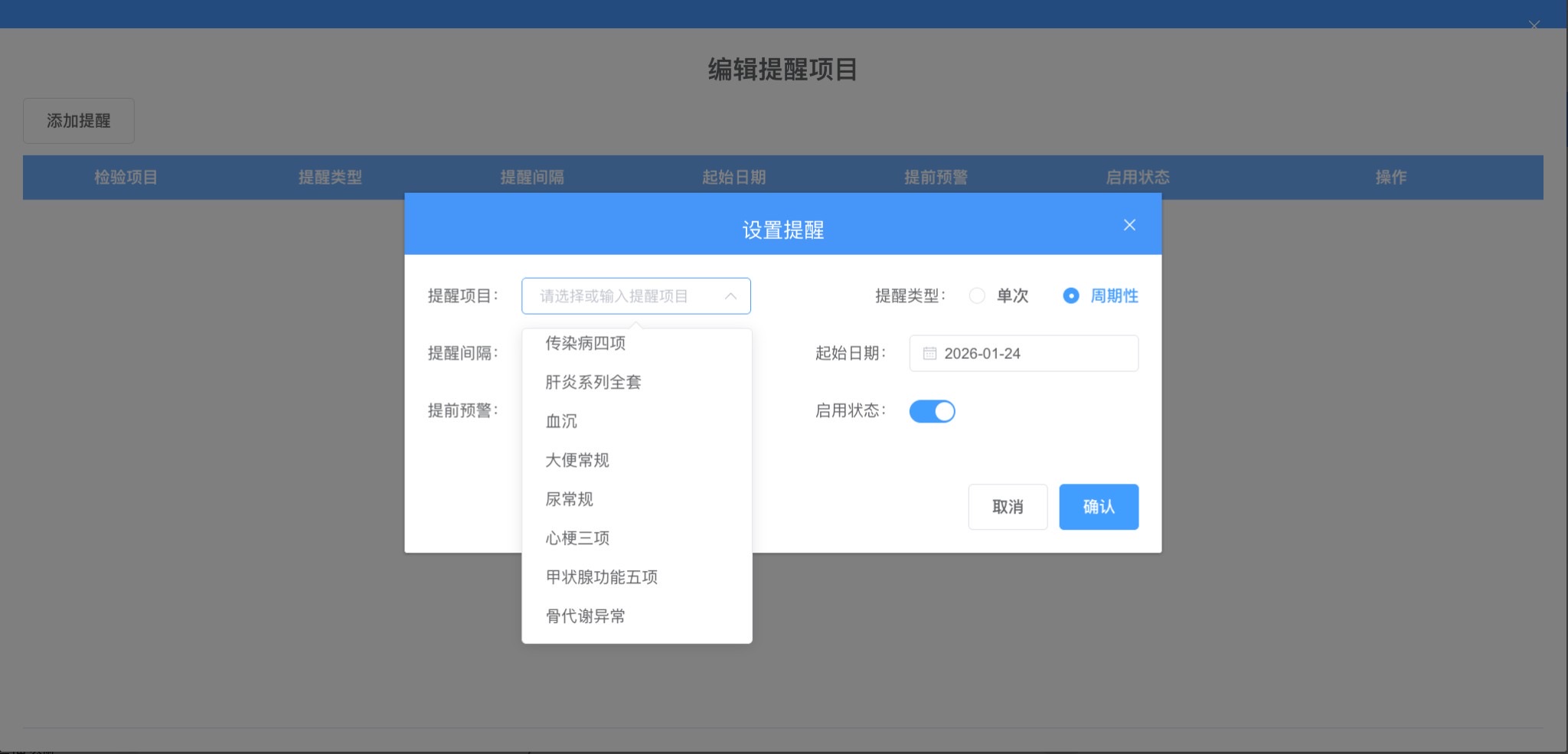
Automatic calculation and reminders, assisting doctors in generating reminder requirements. One-click creation of long-term personalized lab plans with automated time prediction, converting tasks into scheduled items.
Intelligent Scheduling
System automatically calculates lab cycles based on test-specific frequencies (weekly, monthly, quarterly), generating smart reminders to ensure complete coverage without duplication.
Personalized Lab Calendars
One-click generation of long-term personalized lab schedules with automated next-test predictions. Shifts from staff-tracked to system-managed—from reactive to proactive.
AI: Automatic reminder calculation, one-click long-term lab plan generation
Four-Item Monitoring Module
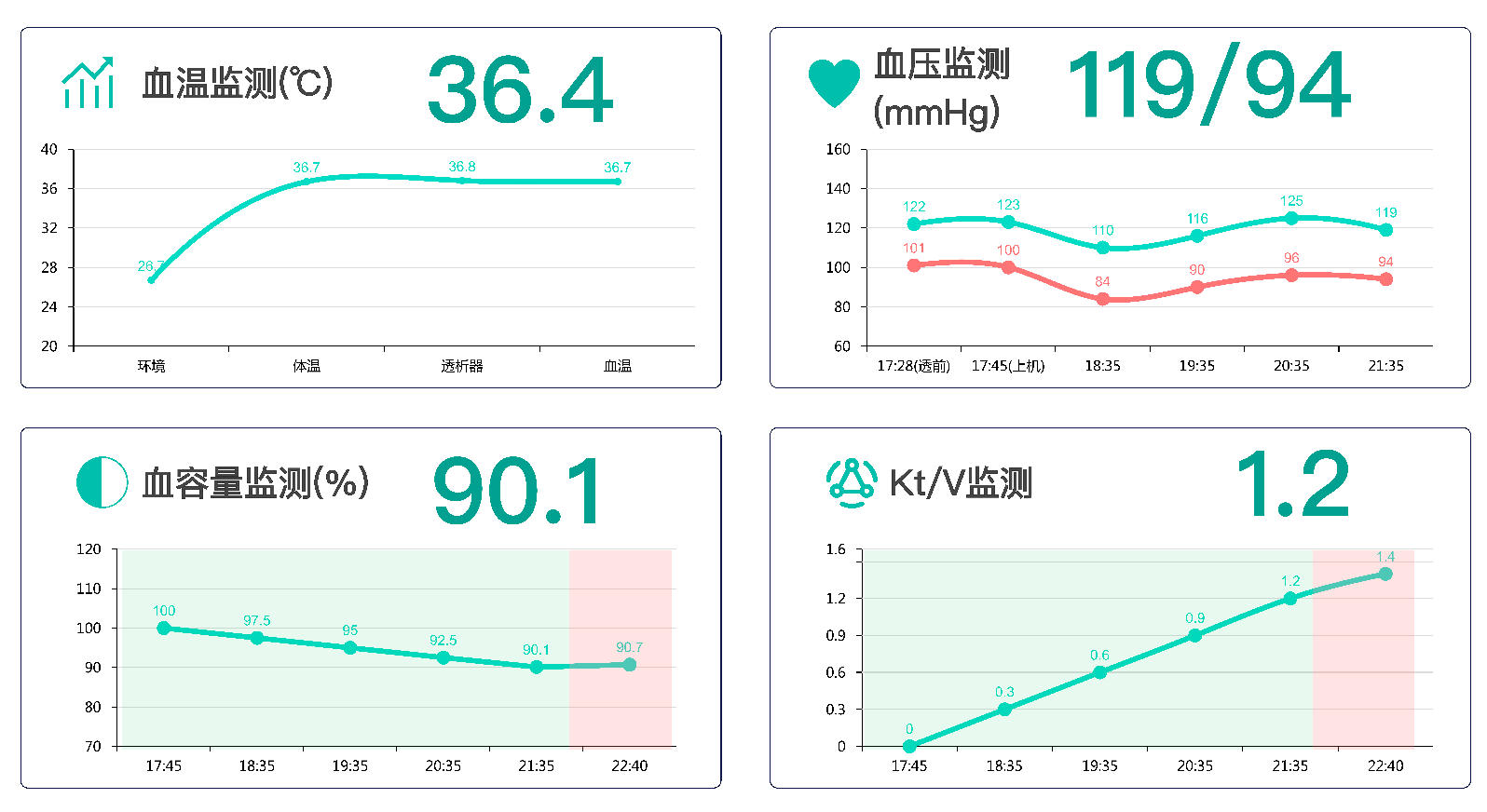
Continuous monitoring and intelligent analysis of BP, Kt/V, Blood Volume, and Blood Temperature
Real-time monitoring of four critical dialysis indicators throughout treatment. Not only capturing current data but tracking historical trends, providing multi-dimensional data support for clinical decisions. Some metrics are obtained directly from dialysis machines, while others are intelligently calculated by AI, ensuring data completeness and accuracy.
BP & Kt/V Monitoring
4G BP monitors with real-time transmission and auto-generated trend charts for hypotension alerts; Kt/V via direct machine reading or AI calculation to ensure dialysis adequacy (KDOQI guideline target: Kt/V ≥1.2).
Blood Volume & Temperature Monitoring
Real-time blood volume monitoring to prevent excessive UF, plus temperature tracking to optimize dialysate settings—some via direct device capture, some AI-calculated.
AI: AI calculation + direct device capture, full tracking and trend analysis of four indicators
Quality Control Module
Structured, visual continuous quality management
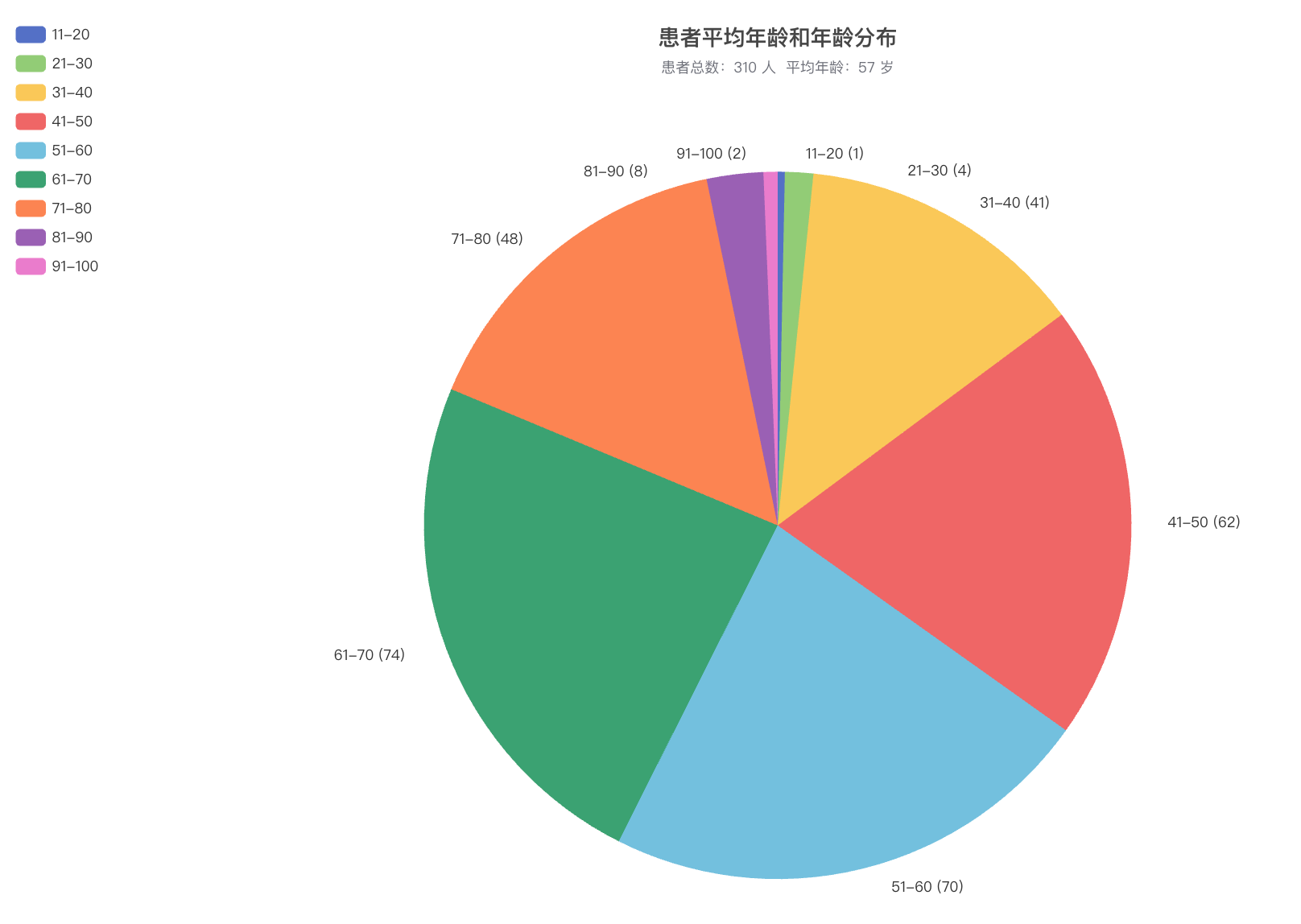
The system automatically aggregates lab results, treatment parameters, and key process indicators into a structured, visual quality control database for dialysis quality assessment, issue tracking, and continuous improvement.
Automated Data Aggregation
Automatically collects and integrates lab results, dialysis parameters, vital signs, and other multi-dimensional data to build a structured quality control database.
Visual QC Dashboard
Presents quality indicators through charts and trend analysis, supporting rapid issue identification and continuous improvement.
AI: Automated quality control data aggregation, supporting standardized execution and continuous improvement
Smart Monitoring: From Rounds to Early Warning
Bed status is colour-graded against configured thresholds on vital signs and dialysis parameters, so an out-of-range reading stands out. The nurses' station shows every bed at once, so the team can look and allocate resources in time. Judgement and response remain with the clinical team.
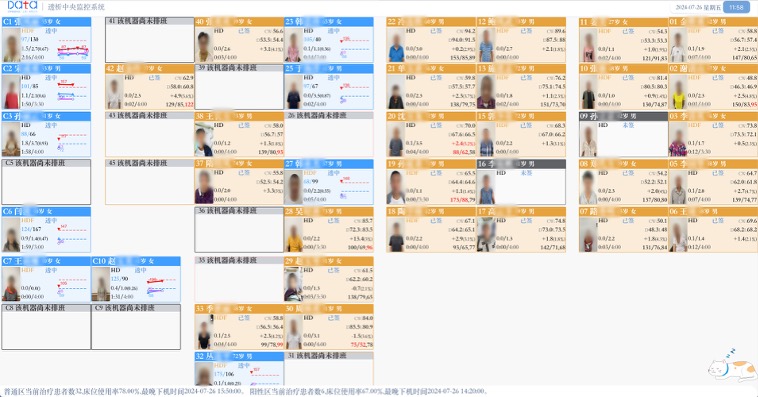
Central Monitoring System
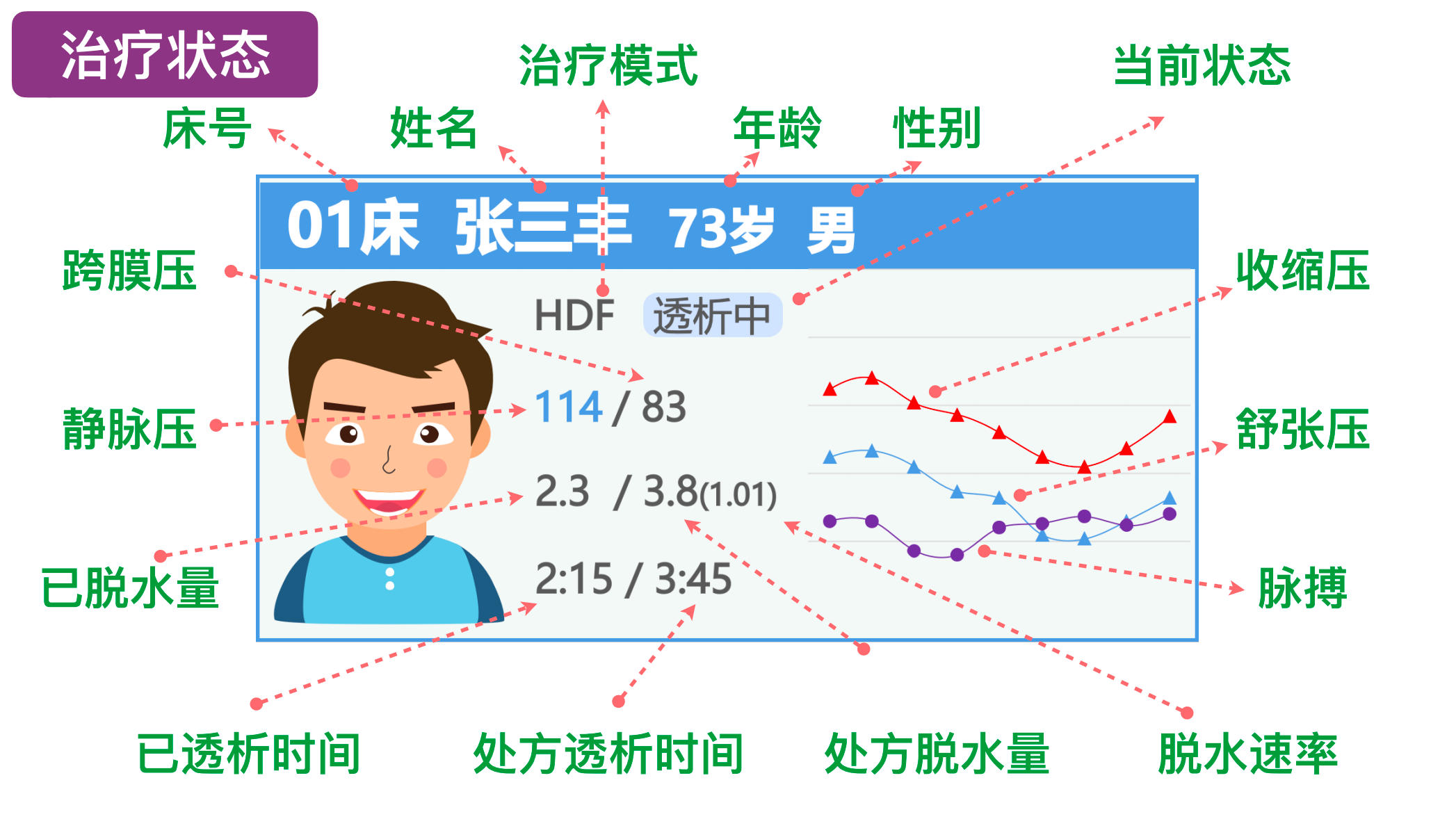
Treatment Status Monitoring
Smart Bedside Terminal — Empowering Every Dialysis Machine with a "Digital Brain"
In traditional hemodialysis workflows, clinical staff often need to check data across multiple systems. The smart bedside terminal redefines the boundaries of bedside devices. It is not just a hardware extension, but a smart navigator deeply integrated into the entire clinical workflow, guiding staff toward more precise and efficient operations.
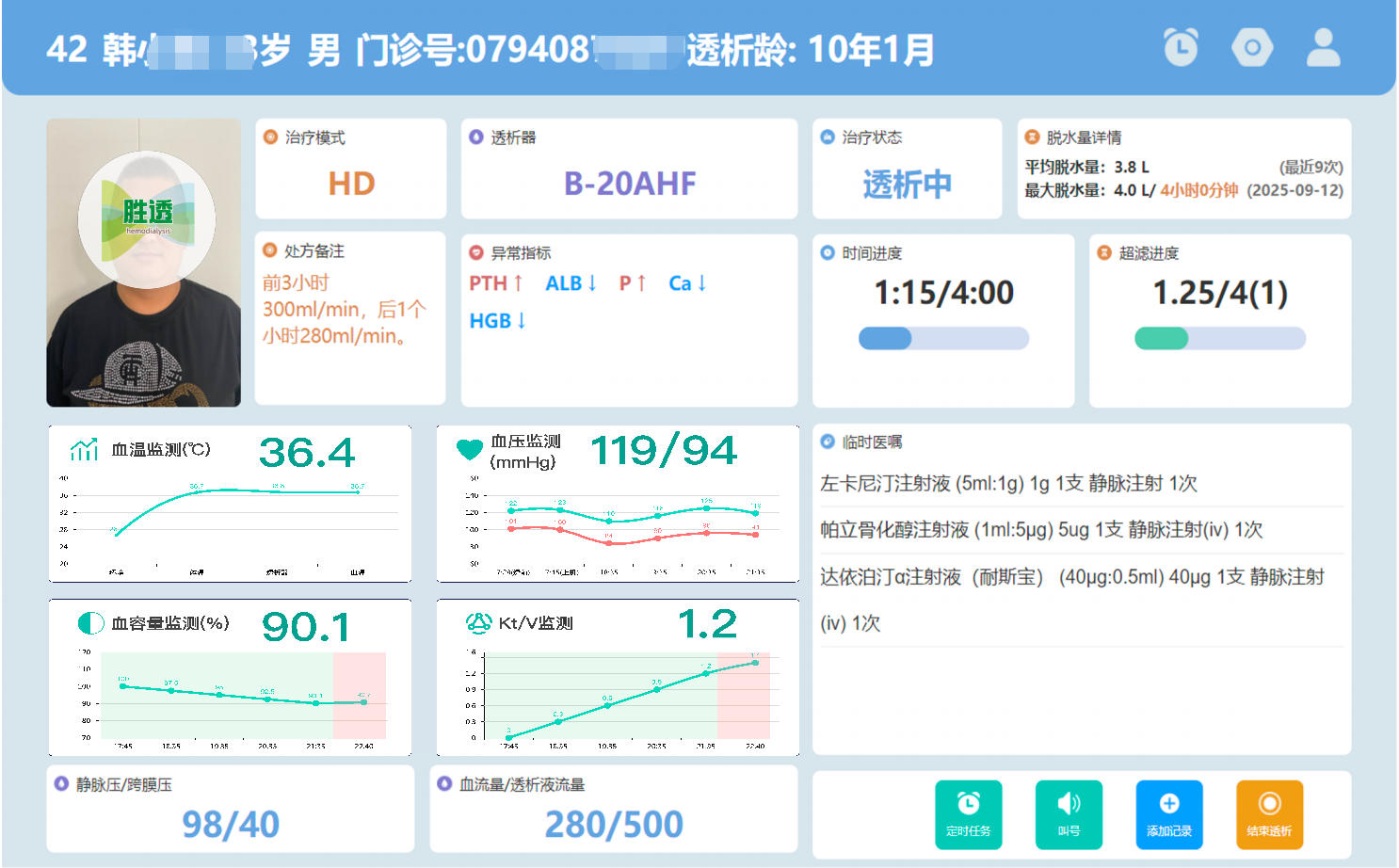
Smart Bedside Terminal
Four-Item Monitoring
Core Value: Full-Scenario Guided Clinical Experience
Pre-Dialysis Preparation
Precise Matching, Zero-Risk Priming
During the preparation phase, the terminal serves as a "verification expert," automatically syncing patient treatment plans:
Automatic Supply Verification
Displays real-time information on required dialyzer models, needle specifications, anticoagulant dosages, and other key details — nurses can match supplies precisely without reviewing medical records.
Priming Process Guidance
Provides standardized guidance during the tubing priming process, ensuring every preparation step is accurate.
During Dialysis
Real-Time Monitoring, Intelligent Early Warning
Once dialysis begins, the terminal becomes an information extension of the machine:
Closed-Loop Monitoring Data
Automatically collects and displays core indicators such as blood pressure fluctuations and four-item monitoring data.
AI Risk Analysis
Not only alerts to potential risks during treatment, but also uses AI algorithms to analyze the root cause, helping nurses address issues proactively rather than reactively.
Real-Time Order Confirmation
Medication orders and temporary adjustments during dialysis can be confirmed with one click on the terminal, greatly simplifying the nurse's workflow.
Physician Rounds
Key Indicators, Doctor's Dashboard
Physicians no longer need to review cumbersome records — the bedside terminal serves as the data hub:
Multi-Dimensional Data Dashboard
Displays a summary of the patient's real-time parameters, historical comparisons, and core biochemical indicators for the day.
Rapid Clinical Decision-Making
Helps physicians quickly grasp the patient's condition at the bedside, improving rounds efficiency and medical safety.